Vergil After Dante
A new poem.

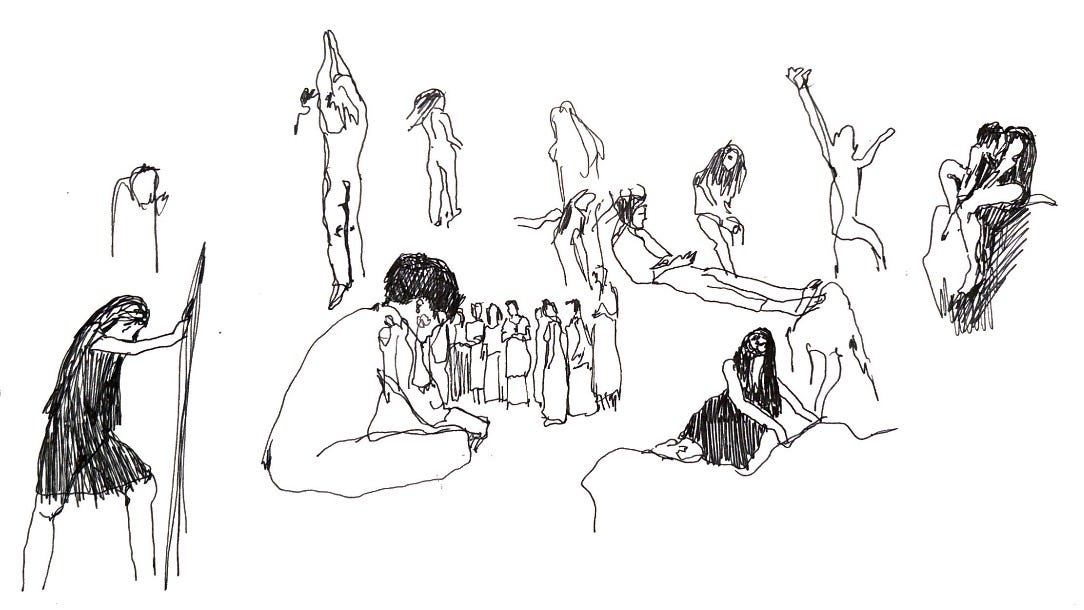

The whole time I’ve been reading The Divine Comedy I’ve been wondering what happens to Vergil after his adventures with Dante. He must just go back to Limbo, the part of Hell where all the virtuous pre-Christian souls mill about for eternity—at least the ones who were left behind after the Harrowing of Hell, when Christ exhumed the heroes of the Old Testament and schlepped them up to Heaven (according to Dante’s Vergil and a few other apocryphal accounts).
In Canto XXVII of Purgatorio, Vergil comes to where he can see no farther. They are on the edge of Eden.
“‘I have brought you here with intellect and skill.
From now on take your pleasure as your guide.
You are free of the steep way, free of the narrow.
* * *
No longer wait for word or sign from me.
Your will if free, upright, and sound.
Not to act as it chooses is unworthy;
over yourself I crown and miter you.’”
Purgatorio, XXVII, 130-142, trans. Jean and Robert Hollander
But he only actually leaves a couple cantos later. He slips away quietly. Dante does not notice that he is gone till he turns to ask him something. “I turned to my left,” Dante writes, “with the confidence / a child has running to his mamma / when he is afraid or in distress.” But his mamma had already started the slow descent back to Limbo.
“And not all our ancient mother lost / could save my cheek, washed in the dew, / from being stained again with tears.” The heavenly Beatrice—Dante’s former lover and current sponsor in Eden—commands him not to cry over Vergil. Dante lowers his eyes to her, like a maiden, and gains a new guide, a new mother (if a more overbearing one).
Good for Dante! But what about our Vergil? What must it be like to go back to Limbo where everything is absolutely static after his time climbing through hell and heaven, meeting wondrous personages, and talking about poetry?
And to think how close Vergil was to salvation, according to Dante. He missed the roundup during Christ’s Harrowing. The satirist Juvenal tells Vergil how much this later Roman poet Statius admires him when he arrives in Limbo around A.D. 140. Vergil later meets Statius who tells him he was responsible for his conversion to Christianity—in a stray line of pagan poetry, an accidental prophecy of Christ. Dante’s Statius practiced his Christianity under the table to avoid persecution. Yet he was saved, and Vergil wasn’t (even though it was his poetry).
A few tears shed, Dante moves on. Vergil, virtuous, on the razor’s edge of salvation, trudges back to Hell.
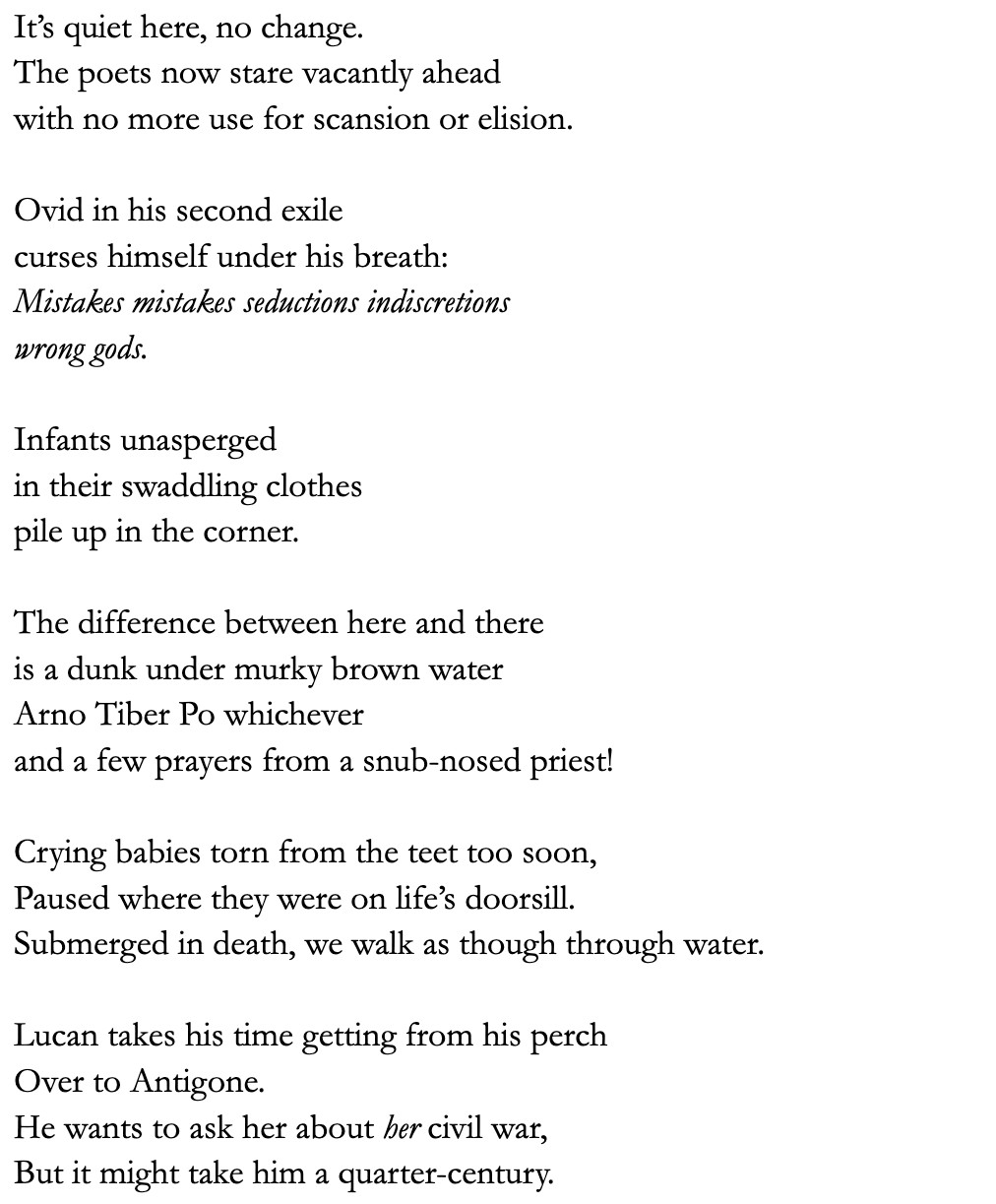
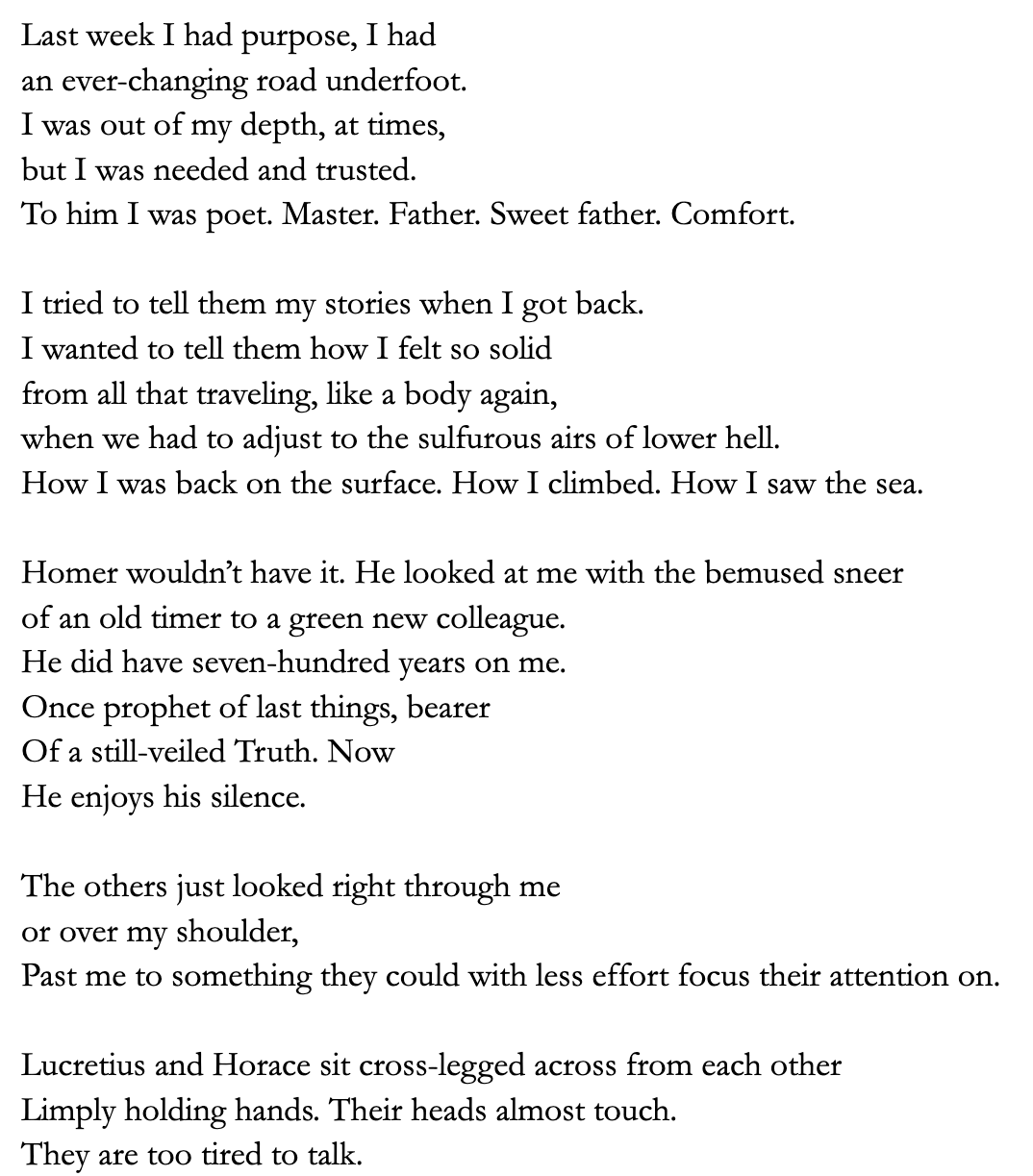
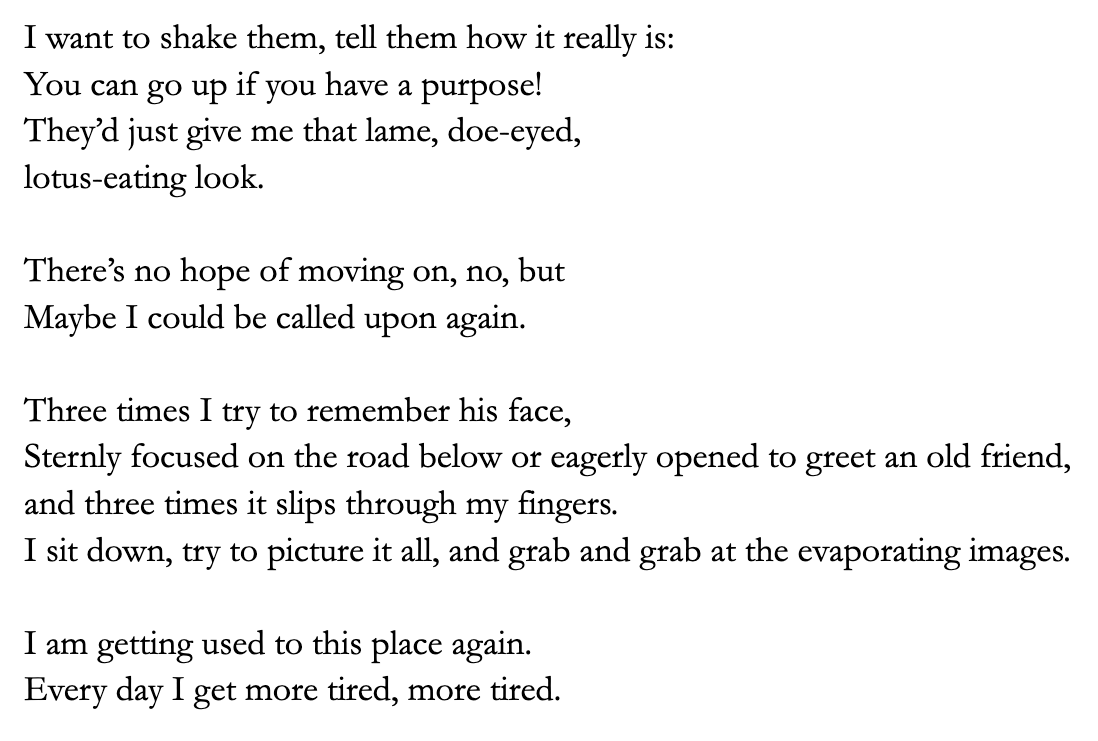
I wrote the following poem in an attempt to understand what Vergil might have been thinking, that first day back in Limbo—a way to say goodbye to the guide I had for a thousand pages.