Graduating Purgatory
It’s not about suffering—it’s about change.

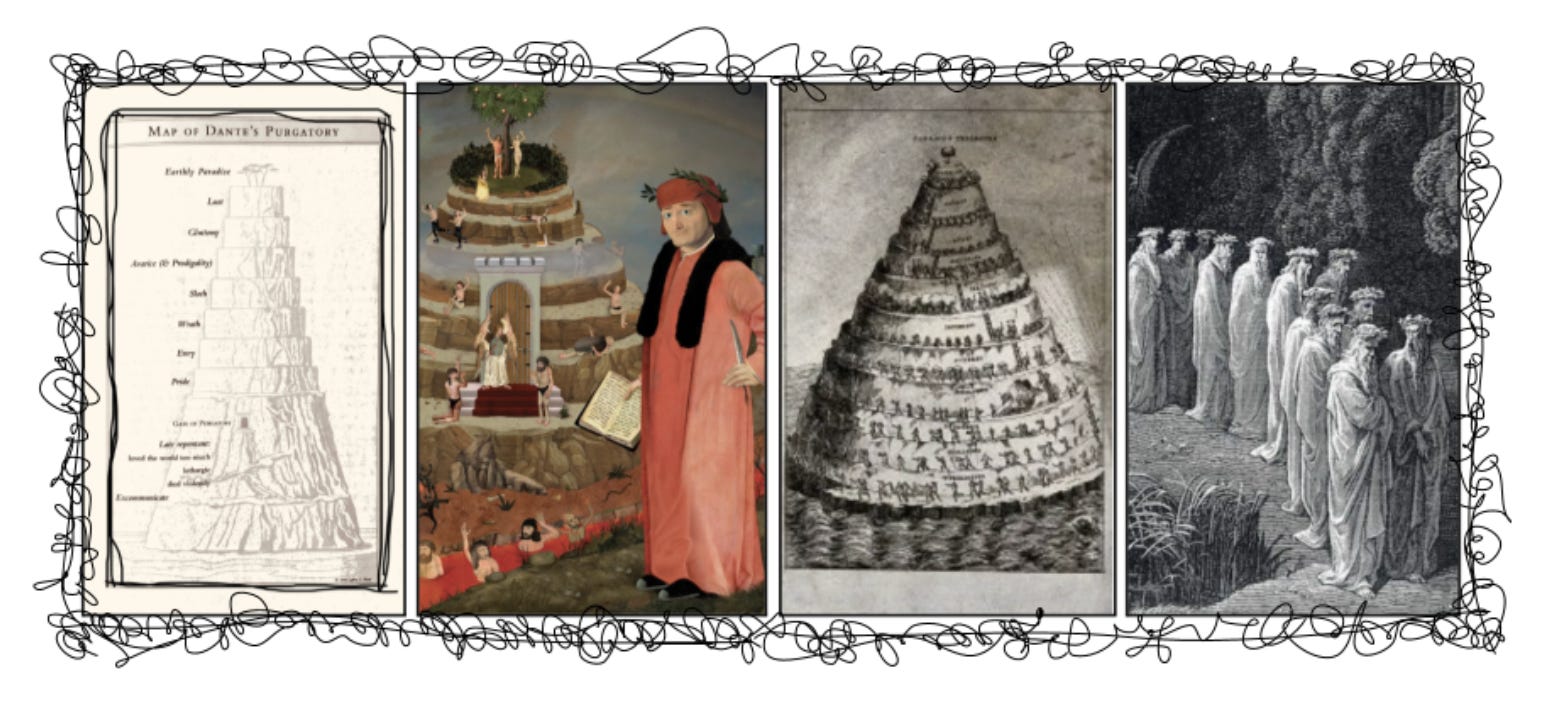
In Dante’s Purgatory, saved souls spend hundreds of years purging their sins, ascending one mountainous terrace at a time until they reach Paradise. But there isn’t a gate or a guard they have to pass on their way up as you might expect—the souls just feel when they’re ready to move on.
The moment at which the epic poet Statius’s soul is thoroughly purged happens before the living Dante and his dead guide Vergil’s eyes. As Statius explains,
‘Here it trembles when a soul feels it is pure,
ready to rise, to set out on its ascent,
and next there follows a great cry.
Of its purity the will alone gives proof,
and the soul, wholly free to change its convent,
is taken by surprise and allows the will its way.’
Purgatorio XXI. 58-63, trans. Jean and Robert Hollander
The will takes the soul “by surprise”: the soul suddenly feels itself to be pure. There is a great tremor in the mountain, a chorus bursts into “Gloria in excelsis Deo,” and the saved soul is ready to change its convent, i.e. ascend to heaven.
Entirely an invention of Dante, of course, but what in Purgatorio isn’t? Unlike hell, in the middle distance he has no real literary precedents. Why shouldn’t it be fitting for the souls to recognize when it has been long enough? Purgatory is all about recognition—Purgatory is the place where you develop the self-awareness of your sins.
The souls can tell Dante and Vergil exactly why they are shriving themselves. On each terrace of sin, they’re being punished for the thing they recognize they’re being punished for. (In the Inferno, by contrast, souls are punished for one thing for eternity, with no hope of change or a moment of recognition.)
Last summer, a year ago almost to the week, my classmates in the year above me at Deep Springs graduated. Halfway through the Dean’s commencement speech, an earthquake pealed through the valley. He happened to be talking about not believing in God. “I felt the mountain tremble / as though it might collapse,” Dante writes. We were outside and I saw the whole world shake. My first earthquake.
So there was no choir of angels. Obviously. But my classmates were definitely moving onto something. The kingdom quaked, shaking them from itself to set them free.
For the past few weeks I’ve been packing up all my stuff, getting ready to graduate myself. All the books I came with are now in boxes. All the books I’ve accumulated are in boxes. My whole education so far has been geometrically fitted into old frozen french fry boxes.
I’ve kept every single piece of paper from my two years here. In the moving process I’ve been trying to decide what to save and what to toss. I can’t take everything with me. What will I want to look at in ten, twenty, thirty years? How will I lighten and unburthen without forgetting something precious? All those insights in the margins of notebooks, loose papers…will they return again in other forms?
As I sifted through my memories, I found my plans for building a chair—that I’m now sitting on. I found my proposal for a conference—that I went to. Notes on class readings I can’t remember doing (like Heidegger’s bloody “Onto-theo-logical Constitution of Metaphysics”). Meal plans from when I was the school cook. Thousands of little indecipherable notes to myself which seemed excessively important at the time.
I found a letter I wrote myself a year ago, in which I wrote: “As much as you may doubt yourself—and I hope that deep-rooted instinct in you will have been tempered by another year of rock, hard place, frying pan, and fryer—you are admired, and worth admiring.” (Not a bad pep talk, nineteen-year old self!)
It has felt like the past two years—or twenty-four moon cycles, whatever Dante would say—have been a burning off, a purging, or weeding out of many of my sins. Notably sloth’s contrapasso is the regular 5:00 a.m. wakeup time. There is nothing to buy in the desert so both avarice and prodigality are out the window. And living in a community of a few dozen people where your friends are your classmates are your coworkers, your pride’s bound to take some serious hits.
What’s to come next will seem like Paradiso. Okay, I haven’t read it yet, but I’m imagining my own Garden of Eden. I’ll be reading all the time. All my meals will be cooked for me, my dishes will be washed for me, I won’t have to ask my professors to buy deodorant for me in town because I can’t leave campus, etc, etc.
But Purgatory is where people change for the better. It’s where people change, period. I know it’s the right time for this “penance” to end. I’m ready to set out, change my convent. But in many ways I’ll miss my punishment. I’ll miss my magic mountain.